
Non-Stop: Traps, Stats, and Big Steps Forward
Hello everyone!
It’s been a while since my last update, and the past couple of months have been packed with progress, travel, and some exciting news for the next stages of the project. Time to catch up.
September started with a high point: my Master’s student, Giulio Roberto Bartuli, successfully presented his TFM. His work on Erythroxylum pollen was impressive to watch come together, and seeing him defend it so confidently was a highlight of the month.
I also submitted an application to the CaixaBank Junior Leader Postdoctoral Fellowship with a new project idea focused on reconstructing past carbon fluxes in Amazonia. The plan is to combine palaeoecological data with modelling approaches like LPJ-GUESS, working with Christelle Hély in Montpellier. Since this is a Retaining call, the goal would be to continue the project here in Barcelona. It’s ambitious and genuinely exciting, and I’m hoping it will open a new line of research into Amazonian carbon dynamics across millennia.
However, life has other plans!! Around the same time, I interviewed with the CEPAM–FORETS team in Nice (Université Côte d’Azur) for a postdoc position working on a lake core from Guatemala to study environmental change around the collapse of the Maya, on the project PAST-FORCE. I’m thrilled to announce that I got the position!!! This will kick off next year in April, and adds a whole new dimension to my research into tropical palaeoecology - new team, new environment, new geographical location and new timeframe focus! It feels good to have a plan in place for after my MSCA, especially one that keeps me within the field of tropical palaeoecology.
October shifted the project into a much more computational phase. I began working closely with statisticians and computer scientists to dig into the modelling parts of my pollen-based climate reconstructions—running methods, validating them, trying to understand what works, what doesn’t, and how to build more robust interpretations.
At the same time, I finally finished processing all the lake and aerial traps. With that, the entire lab component of this project is wrapped. It felt like closing a chapter, although there are still samples left to count whenever I get a chance to get back to the microscope. I would love to finish counting all the samples we planned before the end of the project.
In October I also attended the second AMAPOLLEN meeting, which was a follow up to last years’ and was a chance to catch up with collaborators from Peru and Ecuador. I presented my first results from my river pollen traps and joined discussions on future field campaigns, group priorities, and upcoming collaborative papers. And somewhere between all of that, I managed to make substantial progress on my PhD paper on Veinte de Enero, which is now very close to submission (though possibly still acouple drafts away).
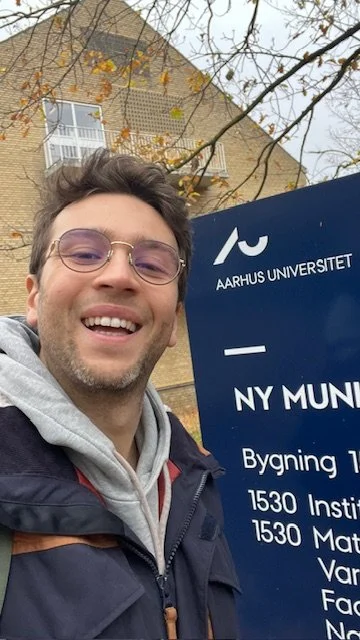
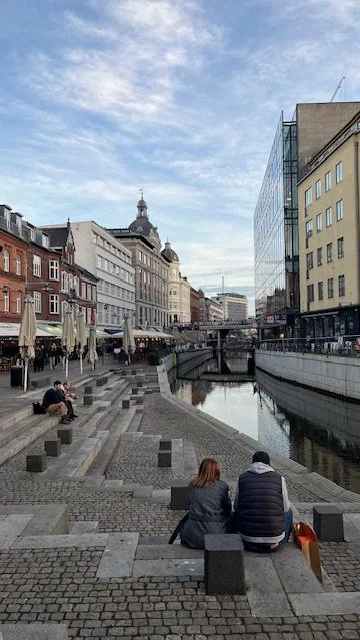
In November, the time finally came for my MSCA secondment at Aarhus University, where I had the chance to spend time working closely with Gavin Simpson. This visit was fully dedicated to ecological statistics—really refining the analytical backbone of the climate reconstructions and discussing other modelling methods. It was intense and incredibly productive. We worked through theories and applications of different validation strategies, data harmonisation approaches, and transformations for ordination analyses. We spent a lot of time on Latent Dirichlet Allocation, especially on how to choose the number of topics in a rigorous way. Beyond the technical progress, the stay in Aarhus opened doors to new collaborations with other researchers and postdocs working at the intersection of ecology, modelling, and statistics. I left with a better statistical toolkit, many new ideas, and a strong sense of momentum for the months ahead. Keep your eyes open for what Gavin and I have planned!
There’s still plenty of work ahead—papers to submit, models to refine, and a couple of big transitions coming up—but these past few months have pushed the project into a new phase where the pieces are finally starting to connect. Considering there isn’t much time left (just over 4 months!), it feels good to have made this kind of progress.
More updates soon!
– Dael